
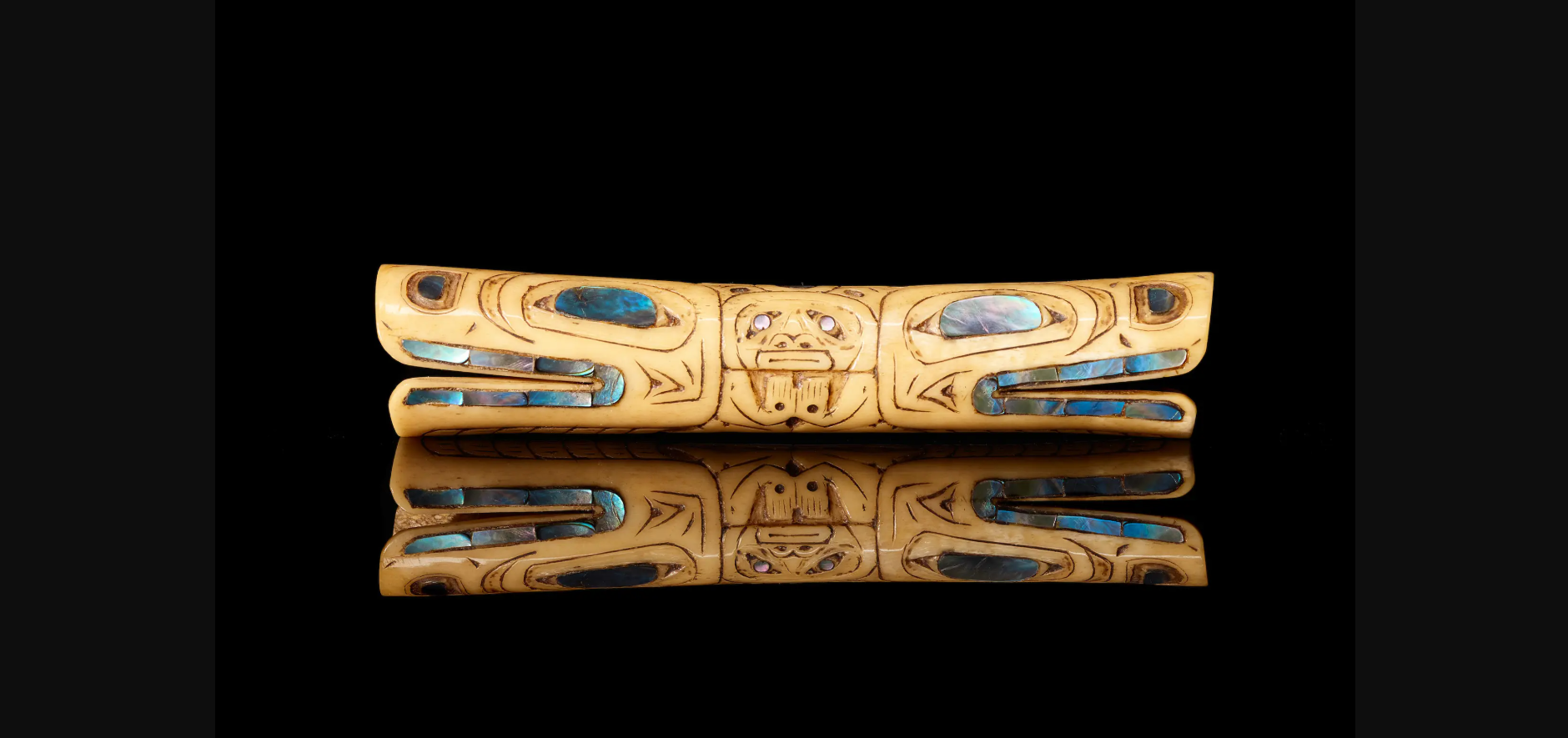
The story behind the soulcatcher
A ‘soulcatcher’ is a sacred healing artifact of the Haida, Tlingit and Tsimshian nations of the Pacific Northwest.
Its use stemmed from the belief that illness was the result of the soul being separated from a person’s physical body
To cure the patient, the shaman would wear the soulcatcher as an amulet and travel to the spirit world. Once the errant soul was located, the shaman would "suck" the wayward soul into the hollow tube and lock it in by plugging the ends with cedar bark. The soul would then be "blown" back into the patient, reuniting body and soul.

It is a beautiful metaphor for our life’s mission: blowing soul and clarity back into organizations.
We envision a world where each organization reveals an authentic, meaningful identity, capable of uniting its teams and standing out in its sector over the long term.
Our mission is to support our clients to clarify their organizational identity, by ensuring a deep alignment between this identity, their internal culture and their employees.

A broader lens, a deeper impact
Our excellence draws its source from the principle of consilience, a concept introduced by biologist Edward O. Wilson in 1998, which designates the convergence of knowledge from different disciplines for a more detailed and holistic understanding of the world.
By crossing our fields of predilection such as sociology, social psychology, strategic management and organizational communication, we combine these perspectives to shed light on the complex dynamics that shape your identity.
We accompany all organizations, regardless of their sector, on a journey of discovery of their organizational identity. We also work closely with communication agencies, HR and change management consultants, and leadership coaches to lay the robust identity foundations necessary in accompanying their clients.
What drives us

Jasper Donker van Heel
I come from a family that has travelled extensively for generations, driven by insatiable curiosity. Some of these forefathers settled in the East Indies, the former Dutch colonial state. Most, but not all my family members were fortunate enough to survive the concentration camps the Japanese set-up during World War II as they dismantled the Dutch colony.
My father was one of them. I was coming of age when he passed away realizing he had never shared any of the family stories nor his own because of the trauma he experienced during the war.
That led to a quest to uncover and piece together my own identity. And has since become my purpose in life to help the companies we encounter reconnect with their identity.
Two things have led me to this unique line of work. A chance encounter with Jan Ardui in 2008 and his mentorship over the years. This has been instrumental in understanding and applying systemic presence, the art of patterning, the modeling of excellence and the ethos of being a humble authority to the field of organizational identity.
I also happen to be born with the trait of sensory-processing sensitivity. It’s a gift that enables us to pick up subtle cues, nuances and patterns most people won’t notice.
Ours is an art and science we have the privilege of engaging in with the passion and dedication of craftsmen.

Fabian Pepe
Many organizations focus on what they do. Few are clear on who they are and what they truly contribute. When identity becomes blurred, culture drifts, teams disengage, strategy fragments, communication becomes noise. I work in that space.
I help organizations seeking meaning understand who they truly are and turn identity into a driver of market differentiation and internal cohesion. Through systemic listening and identity workshops, I help leadership teams align, purpose, culture, vision and brand.
The question is simple. Is there something clear enough to magnify? AI will scale whatever you are. Better make sure you know.
I work with leaders who sense something is off after growth, merger, repositioning, or cultural fatigue.
My role? To listen until the truth becomes audible. Then help the organization act from it.
People want to work with and for organizations they believe in. What’s your message to them?
Let’s find out - together.